Everything You Need to Know About House Rent Allowance (HRA) Exemption Under Income Tax
Welcome Everything You Need to Know About House Rent Allowance (HRA) Exemption Under Income Tax. HRA is a part of your salary that helps you save tax if you live in a rented house. To claim this benefit, you must actually pay rent and keep proofs like rent receipts, landlord’s PAN (if rent is above ₹1 lakh yearly), or a rent agreement. The tax-free amount is always the lowest of three: the HRA your employer pays you, the rent you pay minus 10% of your salary, or 50% of your salary if you stay in a metro city (40% in non-metro areas). If you live with parents and pay them rent, you can also claim HRA, but it should be supported by proper rent documents. With the right records, HRA becomes one of the simplest and most effective ways to reduce your income tax.
Latest Updates on HRA Exemption for FY 2025-26
or FY 2025-26 (AY 2026-27), the rules for House Rent Allowance (HRA) exemption under Section 10(13A) remain unchanged, but remember that it can only be claimed under the old tax regime. If you are a salaried employee and receive HRA as part of your pay, you can continue to save tax provided you actually live in rented accommodation and maintain proper proof of rent payments. For those who don’t get HRA in their salary, a deduction can still be claimed under Section 80GG, subject to specific conditions like not owning a residential property at your place of work. This makes HRA an important and flexible tax-saving option for many employees.
At the same time, the Income Tax Department has introduced stricter compliance requirements to prevent misuse. If your annual rent exceeds ₹1,00,000, quoting your landlord’s PAN is now mandatory. The latest ITR forms also ask for detailed disclosures like actual HRA received, rent paid, landlord’s name and address, and PAN (if applicable). Claims supported only by fake or cash-based rent receipts are likely to be rejected during assessment. To stay safe, keep a rent agreement, regular rent receipts, and proof of digital rent payments such as bank transfers or UPI transactions. Following these steps will not only help you claim HRA smoothly but also ensure that your exemption stands valid during scrutiny.
What is House Rent Allowance (HRA) in Salary?
House Rent Allowance (HRA) is a part of your salary that your employer gives you to help cover the cost of living in a rented house. It is not fully taxable – a portion of it can be claimed as tax exemption if you actually pay rent and meet the conditions set by the Income Tax Act. This makes HRA one of the most common and useful ways for salaried people to reduce their taxable income.
Meaning of HRA for Salaried Employees
For salaried employees, HRA simply means financial support from the employer to manage rent expenses. The amount of exemption depends on factors like how much rent you pay, your salary structure, and whether you live in a metro city or a non-metro. If you stay in your own house or do not pay any rent, you cannot claim this benefit. With proper documents like rent receipts and a rent agreement, salaried employees can easily take advantage of HRA to save on income tax.
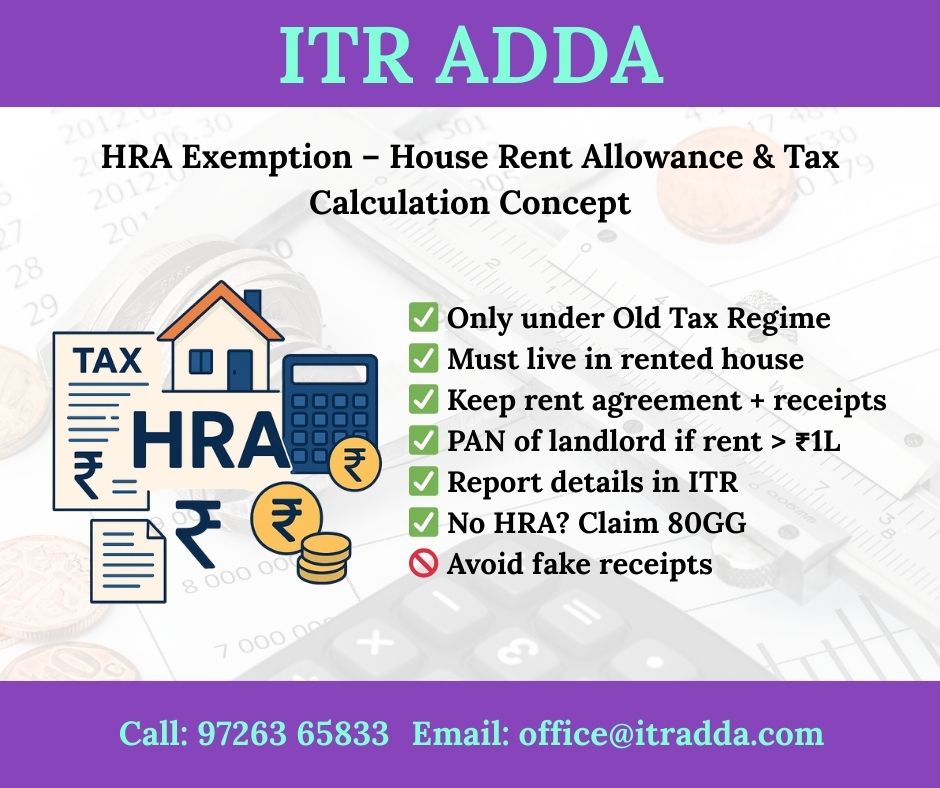
Eligibility to Claim HRA Exemption (Salary & Professional Cases)
✅ You must be a salaried employee, and HRA should be included in your salary package/CTC.
✅ You should actually be living in a rented house/flat and paying rent to the landlord.
✅ HRA exemption can be claimed only under the old tax regime, not under the new one.
✅ If your annual rent is more than ₹1,00,000, you need to provide your landlord’s PAN.
✅ You can claim HRA even if you stay with your parents and pay them rent (with proper receipts & rent agreement).
✅ You cannot claim HRA if you are living in your own house and not paying rent.
✅ If you pay rent to your spouse, HRA claim is not allowed, as it is considered invalid.
✅ The exemption is calculated based on the lowest of three conditions: (i) actual HRA received, (ii) rent paid minus 10% of salary, or (iii) 50% of salary for metro/40% for non-metro cities.
✅ Rent receipts, rent agreement, and proof of payment (like bank transfer, cheque, UPI) are necessary to support your claim.
✅ If you are self-employed or a professional, you cannot claim HRA but you may claim deduction under Section 80GG, subject to conditions.
✅ Even if your employer doesn’t collect rent proofs monthly, you must submit them at the end of the year to avoid TDS on the HRA amount.
✅ The house you pay rent for should not be owned by you; if it is, HRA exemption won’t apply.
Metro vs Non-Metro City HRA Rules (50% vs 40%)
Metro Cities (Delhi, Mumbai, Kolkata, Chennai): You can claim HRA exemption up to 50% of your basic salary (plus DA, if it forms part of salary).
Non-Metro Cities (all other cities): The exemption limit is up to 40% of your basic salary (plus DA, if applicable).
This difference exists because rent in metro cities is usually higher compared to non-metro areas.
While calculating HRA exemption, the system always considers the least of the three amounts:
Actual HRA received from employer
Rent paid minus 10% of salary
50% of salary (for metro) or 40% of salary (for non-metro)
If you live in your own house (metro or non-metro), you cannot claim HRA.
Always keep proper rent receipts and a rent agreement to validate your claim.
Required Documents for Claiming HRA Exemption
To claim HRA exemption, keeping proper documents is very important. These documents not only help you get the tax benefit but also protect you in case of an income tax scrutiny.
Documents Needed:
- Rent Agreement: A formal rental agreement between you and your landlord (highly recommended).
- Rent Receipts: Signed by the landlord for the rent paid during the year.
- Landlord’s PAN: Mandatory if your annual rent exceeds ₹1,00,000.
- Proof of Rent Payment: Bank transfer, cheque, UPI, or any traceable payment method (helps during scrutiny).
- Employer Declaration (if applicable): Some companies may require submission of rent proof for processing HRA in salary.
How to Calculate Your HRA Exemption - Step Method
House Rent Allowance (HRA) helps salaried employees save tax on rent paid. The exemption is calculated based on salary, rent paid, and city of residence. Here’s a simple step-by-step method to find out how much HRA is tax-free.
Step 1: Collect your details
Actual HRA received from your employer.
Your salary for HRA purposes = Basic Salary + Dearness Allowance (if it forms part of retirement benefits).
Actual rent paid during the period.
Step 2: Do the three calculations
Actual HRA received.
50% of salary (for metro cities) or 40% of salary (for non-metro cities).
Rent paid minus 10% of salary.
Step 3: Find the exemption
Compare all three values.
The lowest of the three is the exempt HRA.
If the result is negative, exemption will be treated as zero.
The balance amount (HRA received – exempt HRA) becomes taxable HRA.
Additional Points to Remember
Exemption cannot be more than the actual HRA you receive.
PAN of landlord is mandatory if annual rent is above ₹1,00,000.
Proper documents like rent receipts, rent agreement, and proof of payment must be kept.
You cannot claim HRA if you live in your own house or if you have opted for the new tax regime.
HRA vs Section 80GG – For Employees Without HRA
Salaried employees can save tax through HRA, but what if you don’t receive HRA from your employer? In that case, Section 80GG allows you to claim a deduction for rent paid, subject to certain conditions. The table below highlights the key differences:
| Feature | HRA | Section 80GG |
|---|---|---|
| Who Can Claim | Salaried employees receiving HRA | Self-employed or salaried employees not receiving HRA |
| Maximum Deduction | As per HRA exemption rules (lowest of 3 amounts) | ₹5,000/month or 25% of total income (whichever is lower) |
| Condition | Must pay rent and live in rented accommodation | Must pay rent, live in rented house, and should not own a house in the same city |
| Required Documents | Rent receipts, rent agreement, landlord PAN (if rent > ₹1,00,000) | Rent receipts, declaration in Form 10B, landlord details |
| Tax Regime | Only under old tax regime | Both old and new regime applicable for deduction |
Tax Benefits & Limitations of HRA
Benefits of HRA
Helps reduce taxable income, so you pay less tax.
Very useful for employees living in metro cities with high rent.
Allows legal tax saving on rent expenses for salaried people.
Can be combined with other deductions like Section 80C for more tax benefit.
Even if only part of your rent is covered, it still gives good tax relief.
Flexible – you can claim HRA if you live in your own city or with parents and pay rent to them (with proper receipts).
Helps maintain savings while managing accommodation costs.
Limitations of HRA
Cannot be claimed if you live in your own house.
Fake or incomplete rent receipts can lead to penalties or scrutiny.
Limited benefit if your salary structure doesn’t have a high HRA component.
HRA is only available under the old tax regime; not allowed in the new tax regime.
If your annual rent is above ₹1,00,000, landlord PAN is mandatory; missing it may cause claim rejection.
Exemption is capped based on your salary and rent, so very high rent may not be fully covered.
Common Mistakes to Avoid While Claiming HRA
Submitting fake rent receipts without actually paying rent
Not providing landlord’s PAN if annual rent exceeds ₹1,00,000
Claiming HRA while living in a self-owned house
Not keeping proof of rent payment (bank transfer, cheque, UPI)
Ignoring a proper signed rent agreement
Incorrect calculation of HRA exemption
Claiming HRA under the new tax regime instead of the old regime
Forgetting to submit rent receipts to the employer on time
Paying rent in cash without any documentation
Not updating rent or landlord details if changed during the year
Claiming HRA for multiple properties simultaneously
Not maintaining proper records for future scrutiny
Penalties and Consequences of Wrong HRA Claim
Interest & Penalty on Wrong HRA Claims
If you claim HRA incorrectly or without proper proof, the Income Tax Department can disallow the exemption.
You will have to pay the tax you avoided, along with interest at 1% per month on the unpaid tax amount.
In cases of deliberate fraud or false claims, an additional penalty of up to 50% of the tax evaded may be imposed.
IT Department Scrutiny & Notices
The IT Department may cross-check your rent receipts and HRA claims with the landlord’s income records.
Submitting fake or fabricated rent receipts can trigger scrutiny, notices, and even prosecution in serious cases.
To avoid penalties, always claim HRA genuinely and maintain proper documents like rent receipts, rent agreement, proof of payment, and landlord PAN (if required).
Your Trusted Guide for Salary & Tax Planning
HRA is one of the easiest and most effective ways for salaried employees to save tax, but it only works if claimed correctly. Many taxpayers make mistakes in calculations, forget to submit rent receipts, or miss landlord PAN details, which can lead to penalties. Proper understanding of HRA rules and careful documentation is key to maximizing your tax benefit safely.
If you’re unsure about HRA calculations, rent agreements, or submitting proofs, it’s best to consult a trusted tax expert. ITRAdda.com provides reliable guidance for HRA claims, salary planning, and other tax-saving strategies, ensuring your tax filing is accurate and stress-free. For quick assistance, call +91-XXXXXXXXXX or visit ITRAdda.com.