Tax Benefits on Home Loan for FY 2025-26
Welcome to our blog Tax Benefits on Home Loan for FY 2025-26. Buying a house with a home loan not only fulfills the dream of owning a home but also helps you save significantly on taxes under the Income Tax Act. The government provides various deductions such as interest payment under Section 24(b), principal repayment under Section 80C, and additional benefits like Section 80EE and 80EEA for first-time buyers. In addition, joint home loans allow both co-borrowers to claim tax deductions separately, doubling the benefits. These tax-saving provisions not only reduce your overall liability but also encourage investment in real estate, making homeownership more affordable. By planning your loan repayment and tax-saving strategy wisely, you can maximize deductions, improve cash flow, and achieve long-term financial stability while creating a valuable asset for the future.
Key Tax Deductions Available on Home Loan
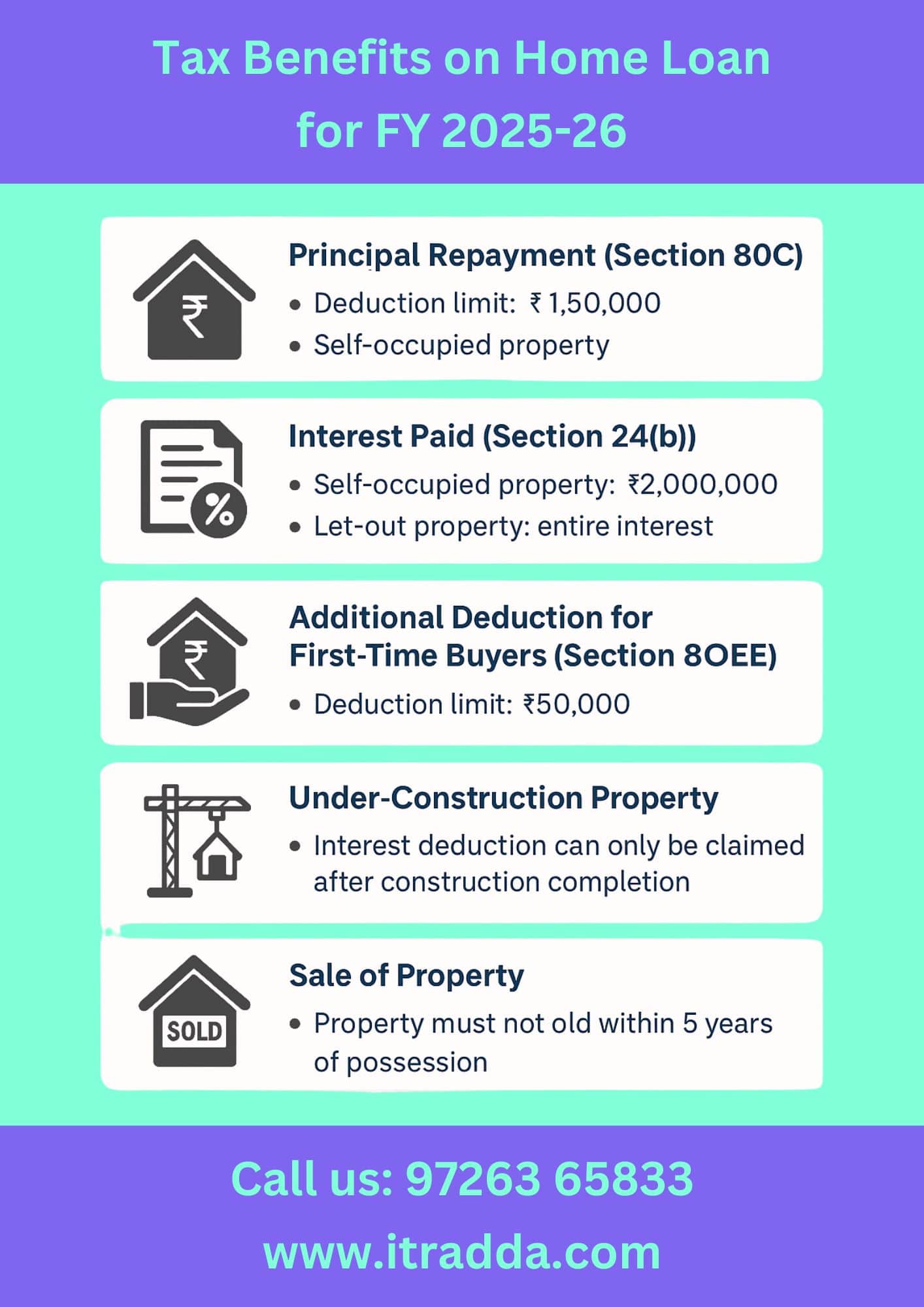
The Income Tax Act provides multiple tax deductions on home loans, covering both principal repayment and interest payment. Under Section 24(b), you can claim up to ₹2,00,000 per year on interest paid for a self-occupied house, while for a rented property, the full interest amount is deductible. Similarly, the principal repayment qualifies under Section 80C, where you can claim up to ₹1,50,000 annually, including expenses like stamp duty and registration charges (in the year they are paid).
Additional benefits are also available for first-time buyers and affordable housing loans. Under Section 80EE, an extra deduction of ₹50,000 can be claimed on interest, while Section 80EEA provides up to ₹1,50,000 additional interest deduction for affordable housing. Moreover, if you have taken a joint home loan, both co-owners can claim tax benefits separately, thereby maximizing the total deduction available. These provisions make home loans not only a path to property ownership but also a smart tool for tax saving.
Eligibility Criteria for Claiming Home Loan Benefits
The home loan must be taken from a recognized bank, NBFC, or housing finance company.
The property must be registered in the name of the taxpayer who is claiming the deduction.
For joint loans, each co-borrower can claim deductions separately, but only if they are also co-owners of the property.
Tax benefits are available only after the construction of the house is completed and possession is taken.
If the property is under construction, interest paid during this period can be claimed later in five equal installments after possession.
The loan should be taken only for purchase, construction, repair, or renovation of a residential property.
For benefits under Section 80EE, the buyer must be a first-time homebuyer and the loan should not exceed the specified limit.
For benefits under Section 80EEA, the loan must be sanctioned within the notified dates and the stamp duty value of the property should not cross the prescribed cap.
Tax deductions are available only if the property is not used for commercial purposes.
The taxpayer must continue to repay the loan; once the loan is fully repaid, no further tax benefits can be claimed.
Rules for Self-Occupied vs Let-Out Property
✅ Self-Occupied Property
- You live in the house yourself.
- Deduction on home loan interest is capped at ₹2,00,000 per year under Section 24(b).
- Principal repayment is eligible under Section 80C (up to ₹1,50,000).
- No rental income is considered for tax.
✅ Let-Out Property (Rented Property)
- You have given the property on rent.
- Entire interest paid on the home loan can be claimed as deduction.
- But, only ₹2,00,000 of loss from house property can be set off against other income in a year.
- Extra loss (if interest is higher) can be carried forward for 8 years.
- Principal repayment under Section 80C is also available.
- Rental income needs to be declared while filing ITR.
Documents Required to Claim Deductions
To claim tax benefits on your home loan, you need to keep certain documents ready as proof. These documents help validate your loan, ownership, and repayment details while filing your Income Tax Return.
- Loan Sanction Letter & Repayment Certificate – Issued by the bank or housing finance company, showing loan details, EMI breakup, and total interest/principal paid.
- Proof of Stamp Duty & Registration Charges – Bills/receipts for payment, which can be claimed under Section 80C in the year of payment.
- Possession or Completion Certificate – Confirms that construction is complete and the property is ready for use, making you eligible for deductions.
- Co-Ownership/Loan Documents – Required if the home loan is joint; ensures each co-borrower and co-owner can claim their share of benefits.
Example of Home Loan Tax Saving Calculation
To understand how home loan tax benefits work, let’s take the case of Mr. A in FY 2025-26. He has taken a home loan for his self-occupied house and during the year, his repayments are as follows:
He paid ₹1,50,000 towards the principal amount, which is fully eligible for deduction under Section 80C (within the limit of ₹1,50,000).
He paid ₹2,20,000 as interest on the loan, but for self-occupied property, the deduction under Section 24(b) is capped at ₹2,00,000.
Being a first-time homebuyer, Mr. A also qualifies for an additional deduction of ₹50,000 under Section 80EE.
Therefore, his total tax deduction is:
₹1,50,000 (80C) + ₹2,00,000 (24b) + ₹50,000 (80EE) = ₹4,00,000.
Limitations & Conditions You Must Know
Deduction limits: ₹1,50,000 under Section 80C and ₹2,00,000 under Section 24(b) for self-occupied property.
Property must not be sold within 5 years of possession; otherwise, deductions under 80C are reversed.
For under-construction property, interest deduction can be claimed only after completion.
Pre-construction interest can be claimed in 5 equal installments starting from the year of possession.
Deductions are not allowed for commercial use of the property.
Joint loan deductions are available only if all co-borrowers are co-owners.
Only loans from recognized banks or housing finance companies are eligible.
First-time buyer benefits (Section 80EE/80EEA) are available only if conditions like loan amount and property value limits are met.
Stamp duty and registration charges can be claimed under Section 80C in the year they are paid.
Tax benefits are available only for a residential property, not for plots of land or commercial buildings.
Loss from house property in case of rented property can be carried forward for 8 years if it exceeds the set-off limit.
Your Trusted Guide for Home Loan Tax Planning
Planning your home loan tax benefits correctly can help you save a significant amount of money over the entire loan tenure. By understanding deductions under Sections 80C, 24(b), 80EE, and 80EEA, you can reduce your taxable income and make your EMIs more manageable. Proper planning ensures that you do not miss out on any eligible benefits and can maximize your savings each financial year.
At ITRAdda.com, we provide expert guidance on all aspects of home loan tax planning, including claiming deductions, understanding eligibility, and filing your income tax returns accurately. Our experienced tax consultants make the process simple and hassle-free, helping you save both time and money while staying fully compliant with the Income Tax Act in FY 2025-26. For assistance, contact us at +91 97263 65833 or visit ITRAdda.com today.